
GORE® EXCLUDER® Thoracoabdominal Branch Endoprosthesis (TAMBE) Pivotal Study Outcomes
Evidence through 1 year
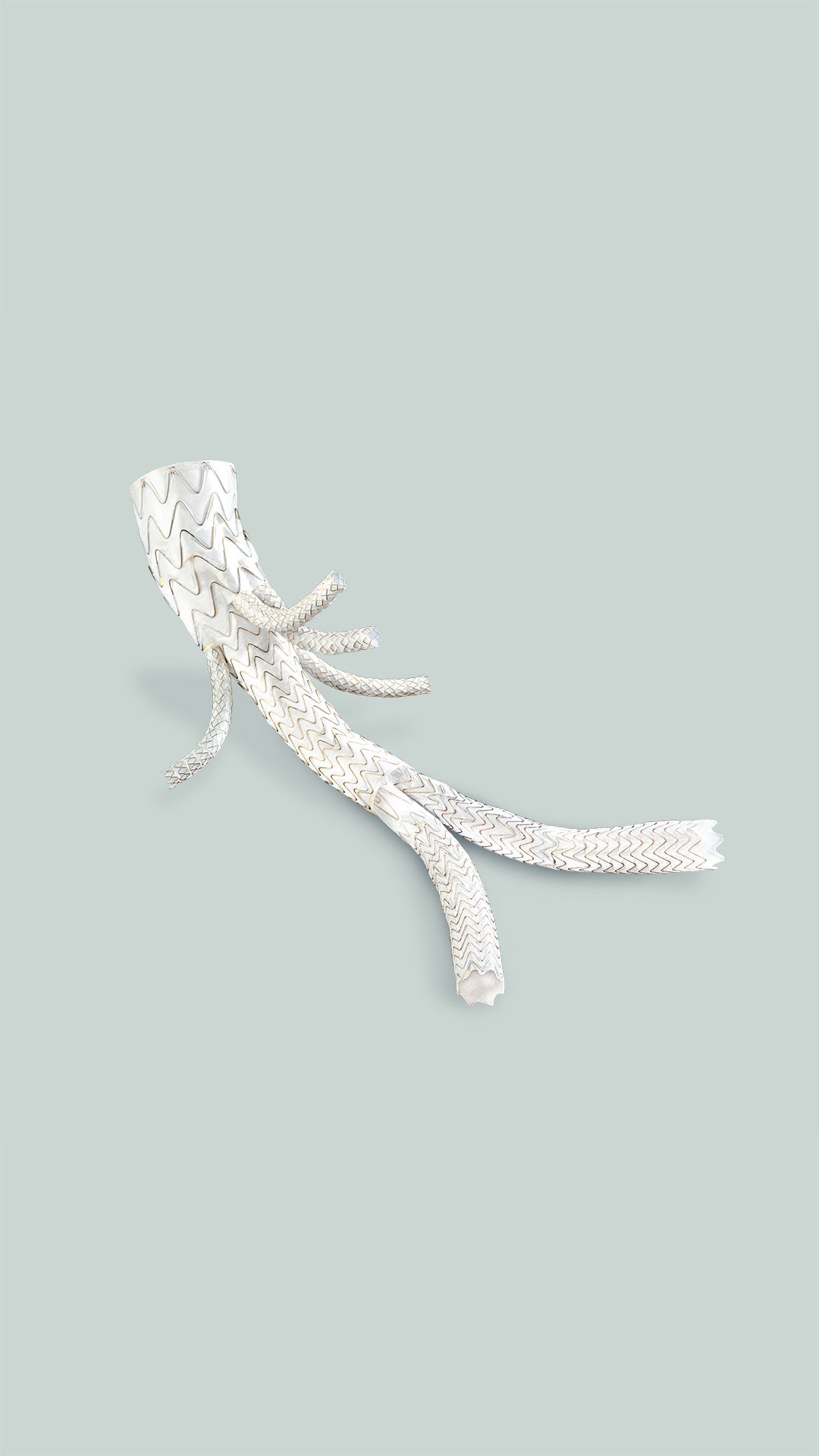
Powered for proof
The TAMBE Pivotal Study1 is the only prospective, multisite, CEC-adjudicated study for an approved thoracoabdominal endovascular solution.
- 102 primary arm patients
- 44 trial sites worldwide
- 60+ participating surgeons
TAMBE was evaluated by a large, diverse group of skilled surgeons across a wide range of patient populations.
Clarity in outcomes
One-year results are the first for a branched endovascular aneurysm repair (BEVAR) device with in-depth patient and vessel-level reporting.
High device effectiveness1
freedom
from lesion-related mortality
freedom
from all-cause mortality
conversions to open repair
reported device migrations
High-complexity cases1
TAMBE demonstrated favorable safety and effectiveness outcomes — with no lesion-related mortality reported through 12 months — reinforcing the role of TAMBE for patients with appropriate anatomy.
| Key patient-level outcomes | n/Na |
|---|---|
Clinically significant reinterventionb through 12 monthsb | 25/85 (29.4) |
| 5/84 (6.0) |
Reintervention-required hospitalizationd | 4/95 (4.2) |
Total occlusiond | 14/95 (14.7) |
Abbreviations: n = number of patients with an event; N = number of evaluable patients
High-risk anatomy1
Branch complications are a known risk in BEVAR. Contributing factors of branch occlusions may include tortuosity, clock-angle offset, minimum aortic diameter, vessel position and orientation, compression and total branch length; however, renal artery size was the only statistically significant risk factor identified.
| Event, n (%) | Total No. of vesselse N = 368 | Renal – left n = 90 | Renal – right n = 89 | Celiac n = 95 | SMA n = 94 |
|---|---|---|---|---|---|
Any target vessel instability | 23 (6.3) | 10 (11.1) | 9 (10.1) | 1 (1.1) | 3 (3.2) |
Occlusion/stenosis overall | 20 (5.4) | 8 (8.9) | 8 (9.0) | 1 (1.1) | 3 (3.2) |
Abbreviations: No. = number; SMA = superior mesenteric artery.
One-year data has really informed us on the surveillance of these patients. And that's one of the main reasons that we use both CT and ultrasound as important pieces of surveillance—to be able to better understand what's going to be the long-term results and patency of all the branches with this new technology.

High technical success2
One-year outcomes build on proven early procedural results at 30 days, with 99% technical success per SVS reporting standards.3
- Median hospital stay following the procedure was 4 days.
- One patient experienced intraoperative aortic rupture due to disruption of a narrow aortic bifurcation during balloon dilatation.
- No additional events of aortic rupture or permanent paraplegia occurred after 30 days and through 12 months.
| 30-day clinical outcomes (n = 102)2 | Events (%) |
|---|---|
Protocol-defined procedural safety events at 30 daysf,g | 8 (7.8%) |
Stented segment aortic rupture | 1 (1.0%) |
Lesion-related mortality | 0 (0.0%) |
Permanent paraplegia | 2 (2.0%) |
Permanent paraparesis | 3 (2.9%)h |
New onset renal failure requiring dialysis | 2 (2.0%) |
Severe bowel ischemia | 0 (0.0%) |
Disabling stroke | 1 (1.0%) |
One year in, TAMBE is delivering
With low rates of all-cause mortality and proven effectiveness, TAMBE continues to bridge gaps in complex visceral aortic aneurysm care.
At Gore, our commitment to your patients’ safety means we will continue to pursue every signal and every outcome—rigorously and responsibly. With continuing follow-up, analysis of intraoperative duplex ultrasound and quality of life outcomes, we’re advancing the evidence base to drive meaningful progress in patient care.
a Denominator represents number of patients with at least one appropriate image in the 12-month analysis window (243-546 days) or have an event of interest were included in calculation all endpoint variables listed with exception of all reintervention.
b As defined by the protocol: a composite of the following events through the 12 month window (to 546 days): device seal zone endoleak, lesion growth >5 mm, rupture, device effectiveness (seal zone/integrity), total occlusion of the device, and reintervention requiring hospitalization.
c Core lab assessment.
d Adjudicated by Clinical Evaluation Committee.
e At 12 months, 95 patients completed a follow-up with imaging. The denominator for individual vessels and total vessel reflects that in some cases, not all vessels were successfully imaged (eg, unable to visualize vessel) and were, therefore, not included in the count.
f One patient had two events: paraplegia and stented segment aortic rupture (protocol defined) and intraoperative aortic rupture.
g Adjudicated by the clinical events committee. Patients with at least 30-day post-procedure follow-up, or an event.
h Two subjects who meet the protocol definition for permanent paraparesis had a full recovery by 6 months after the procedure. At 30 days, TAMBE was shown to be safe and effective in patients with complex aneurysms involving the visceral aorta — delivering strong technical success, no mortality and low rates of safety events.
Farber, Mark A. et al. 1-year Results from the Pivotal Trial of a 4-Branch Thoracoabdominal Branch Endoprosthesis. Journal of Vascular Surgery, Volume 81, Issue 6, e236.
Farber MA, Matsumura JS, Han S, et al. Early outcomes from the pivotal trial of a four-branch off-the shelf solution to treat complex abdominal and type IV thoracoabdominal aortic aneurysms. Journal of Vascular Surgery. 2024;80(5):1326-1335.e4. doi:10.1016/j.jvs.2024.05.020
Oderich GS, Forbes TL, Chaer R, et al. Reporting standards for endovascular aortic repair of aneurysms involving the renal-mesenteric arteries. Journal of Vascular Surgery, 2021;73(1S):4S-52S.

Refer to Instructions for Use at eifu.goremedical.com for a complete description of all applicable indications, warnings, precautions and contraindications for the markets where this product is available. RXOnly
INDICATIONS FOR USE IN THE U.S.: The GORE® EXCLUDER® Thoracoabdominal Branch Endoprosthesis is indicated for endovascular repair in patients with thoracoabdominal aortic aneurysms and high-surgical risk patients with pararenal aortic aneurysms who have appropriate anatomy as described below: Adequate iliac/femoral access and brachial/axillary access; proximal (supraceliac) aortic neck treatment diameter range over 2 cm seal zone of 22-34 mm for aneurysms extending up to 6.5 cm or less above the origin of the most proximal branch vessel; aortic neck angle ≤ 60° at the Aortic Component proximal seal zone; iliac artery treatment diameter range of 8-25 mm and iliac artery seal zone length of at least 10 mm; renal artery seal zone diameters between 4.0-10.0 mm; celiac and superior mesenteric artery seal zone diameters between 5.0-12.0 mm; ≥ 15 mm seal zone length in renal arteries, superior mesenteric artery and celiac artery; and visceral segment of aorta (3 cm proximal through 9.5 cm distal to the most proximal visceral artery) must be ≥ 20 mm in diameter.
CONTRAINDICATIONS: The GORE® EXCLUDER® Thoracoabdominal Branch Endoprosthesis is contraindicated in: Patients with known sensitivities or allergies to the TAMBE materials including ePTFE, FEP, nickel titanium alloy (Nitinol), stainless steel and gold. Patients who have a condition that threatens to infect the graft. Patients with known hypersensitivity to heparin, including patients who have had a previous incident of Heparin-Induced Thrombocytopenia (HIT) type II and cannot receive the GORE® VIABAHN® VBX Balloon Expandable Endoprosthesis.
Products listed may not be approved in all markets.