
Endoprotesi GORE® VIABAHN® con superficie bioattiva PROPATEN* Dati clinici
Apri più possibilità con la protesi VIABAHN® Device
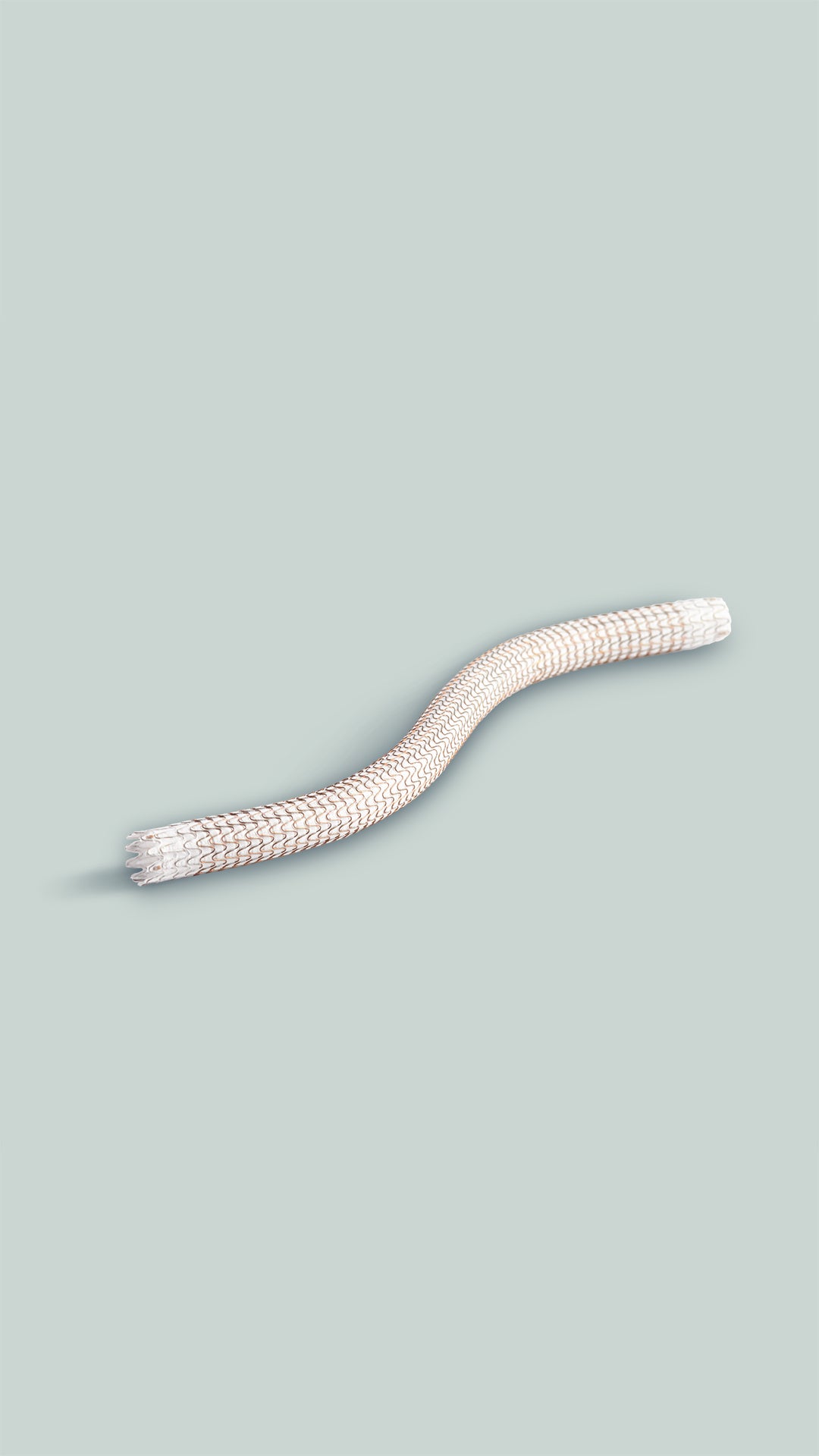
La versatilità della protesi VIABAHN®, comprovata in un ampio spettro di patologie complesse, consente di ottenere elevata pervietà e risultati duraturi per ridurre al minimo i reinterventi.
Consideri i tipi di casi che tratta e le complessità che presentano; la protesi VIABAHN® l'aiuta a ottimizzare i risultati clinici per i suoi pazienti.
Accesso arterovenoso (AV)
La protesi VIABAHN® ha dimostrato successo nei casi di accesso AV più complessi, tra cui insuccessi precoci dell'angioplastica percutanea transluminale (PTA), lesioni ai punti di flessione e nelle protesi trombizzate.
Concepita per conformarsi all'anatomia complessa e ha dato prova di resistere alle fratture†
Ha dato prova di pervietà indipendente dal numero di interventi precedenti1
Pervietà primaria aumentata nelle protesi trombizzate della lesione target e del circuito rispetto alla PTA.1
Arteria femorale superficiale (SFA)
La protesi VIABAHN® garantisce ottime prestazioni cliniche nei casi più complessi con l'80% di pervietà primaria media§ dimostrato in setti studi multicentrici, prospettici, randomizzati o a braccio singolo con una lunghezza media della lesione di 23 cmI e il 71% di occlusioni totali croniche (CTO).2-8
Risultati clinici sovrapponibili al bypass chirurgico sopragenicolare (vena protesica e nativa)2,9
Eccellente pervietà e durabilità a prescindere dalla lunghezza della lesione2-6
Ristenosi intrastent (ISR) dell'SFA
La protesi VIABAHN® offre un trattamento duraturo per le lesioni ristenotiche intrastent complesse.10,11
Capacità di coprire e sigillare la parte malata, che porta a risultati duraturi nell'ISR lunga, complessa10,11
Arteria iliaca
La protesi VIABAHN® è indicata per il trattamento delle lesioni iliache stenotiche.
La famiglia di protesi VIABAHN® ha dimostrato una pervietà che si avvicina ai risultati del bypass chirurgico.12-14
Pubblicazioni
I suoi riferimenti per le pubblicazioni e i dati clinici attuali che dimostrano l'utilità della protesi VIABAHN® nella pratica.
Twelve-month outcomes from the Japanese post-market surveillance study of the Viabahn Endoprosthesis as treatment for symptomatic peripheral arterial disease in the superficial femoral arteries
Iida O, Ohki T, Soga Y, et al. Twelve-month outcomes from the Japanese post-market surveillance study of the Viabahn Endoprosthesis as treatment for symptomatic peripheral arterial disease in the superficial femoral arteries. Journal of Endovascular Therapy 2022;29(6):855-865.
Long-term results of the Japanese multicenter Viabahn trial of heparin bonded endovascular stent grafts for long and complex lesions in the superficial femoral artery
Ohki T, Kichikawa K, Yokoi H, et al. Long-term results of the Japanese multicenter Viabahn trial of heparin bonded endovascular stent grafts for long and complex lesions in the superficial femoral artery. Journal of Vascular Surgery 2021;74(6):1958-1967.e2.
Stent-grafts are the best way to treat complex in-stent restenosis lesions in the superficial femoral artery: 24-month results from a multicenter randomized trial
Bosiers M, Deloose K, Callaert J, et al. Stent-grafts are the best way to treat complex in-stent restenosis lesions in the superficial femoral artery: 24-month results from a multicenter randomized trial. Journal of Cardiovascular Surgery 2020;61(5):617-625.
Clinical and economic benefits of stent grafts in dysfunctional and thrombosed hemodialysis access graft circuits in the revise randomized trial
Mohr BA, Sheen AL, Roy-Chaudhury P, Schultz SR, Aruny JE; REVISE Investigators. Clinical and economic benefits of stent grafts in dysfunctional and thrombosed hemodialysis access graft circuits in the REVISE Randomized Trial. Journal of Vascular & Interventional Radiology 2018;30(2):203-211.e4.
Outcomes of the Japanese multicenter Viabahn trial of endovascular stent grafting for superficial femoral artery lesions
Ohki T, Kichikawa K, Yokoi H, et al. Outcomes of the Japanese multicenter Viabahn trial of endovascular stent grafting for superficial femoral artery lesions. Journal of Vascular Surgery 2017;66(1):130-142.e1.
1-year results of a multicenter randomized controlled trial comparing the heparin-bonded endoluminal bypass to the femoropopliteal bypass
Reijnen MMPJ, van Walraven LA, Fritschy WM, et al. 1-year results of a multicenter randomized controlled trial comparing heparin-bonded endoluminal to femoropopliteal bypass. JACC: Cardiovascular Interventions 2017;10(22):2320-2331.
Sustained benefit at 2 years for covered stents versus bare-metal stents in long SFA lesions: the VIASTAR trial
Lammer J, Zeller T, Hausegger KA, et al. Sustained benefit at 2 years for covered stents versus bare-metal stents in long SFA lesions: the VIASTAR trial. Cardiovascular & Interventional Radiology 2015;38(1):25-32.
Heparin-bonded, expanded polytetrafluoroethylene-lined stent graft in the treatment of femoropopliteal artery disease: 1-year results of the VIPER (Viabahn Endoprosthesis with Heparin Bioactive Surface in the treatment of Superficial Femoral Artery Obstructive Disease) Trial
Saxon RR, Chervu A, Jones PA, et al. Heparin-bonded, expanded polytetrafluoroethylene-lined stent graft in the treatment of femoropopliteal artery disease: 1-year results of the VIPER (Viabahn Endoprosthesis with Heparin Bioactive Surface in the Treatment of Superficial Femoral Artery Obstructive Disease) Trial. Journal of Vascular & Interventional Radiology 2013;24(2):165 173.
* Come inteso da GORE, superficie bioattiva PROPATEN si riferisce alla superficie eparinata CBAS® di proprietà di Gore.
† In tutte le indicazioni, l'endoprotesi GORE® VIABAHN® ha segnalato un tasso di fratture dello 0,0013% (dati in archivio 2025; W. L. Gore & Associates, Inc; Flagstaff, AZ.)
‡ Media ponderata di pervietà primaria a un anno.
I Media ponderata della lunghezza della lesione.
- Vesely T, DaVanzo W, Behrend T, Dwyer A, Aruny J. Balloon angioplasty versus Viabahn stent graft for treatment of failing or thrombosed prosthetic hemodialysis grafts. Journal of Vascular Surgery 2016;64(5):1400-1410.e1. http://www.sciencedirect.com/science/article/pii/S0741521416301756
- Reijnen M, van Walraven L, Fritschy W, et al. 1-year results of a multicenter, randomized controlled trial comparing heparin-bonded endoluminal to femoropopliteal bypass. Journal of Cardiovascular Interventions 2107;10(22):2320-2331.
- Ohki T, Kichikawa K, Yokoi H, et al. Long-term results of the Japanese multicenter Viabahn trial of heparin bonded endovascular stent grafts for long and complex lesions in the superficial femoral artery. Journal of Vascular Surgery 2021;74(6):1958-1967.e2.
- Saxon RR, Chervu A, Jones PA, et al. Heparin-bonded, expanded polytetrafluoroethylene-lined stent graft in the treatment of femoropopliteal artery disease: 1-year results of the VIPER (Viabahn Endoprosthesis with Heparin-bonded Bioactive Surface in the Treatment of Superficial Femoral Artery Obstructive Disease) Trial. Journal of Vascular & Interventional Radiology 2013;24(2):165-173.
- Lammer J, Zeller T, Hausegger KA, et al. Sustained benefit at 2 years for covered stents versus bare-metal stents in long SFA lesions: the VIASTAR Trial. Cardiovascular & Interventional Radiology 2015;38(1):25-32.
- Zeller T, Peeters P, Bosiers M, et al. Heparin-bonded stent-graft for the treatment of TASC II C and D femoropopliteal lesions: the Viabahn-25 cm Trial. Journal of Endovascular Therapy 2014;21(6):765-774.
- Iida O, Ohki T, Soga Y, et al. Twelve-month outcomes from the Japanese post-market surveillance study of the Viabahn Endoprosthesis as treatment for symptomatic peripheral arterial disease in the superficial femoral arteries. Journal of Endovascular Therapy 2022;29(6):855-865.
- Iida O, Takahara M, Soga Y, et al; VANQUISH Investigators. One-year outcomes of heparin-bonded stent-graft therapy for real-world femoropopliteal lesions and the association of patency with the prothrombotic state based on the prospective, observational, multicenter Viabahn Stent-Graft Placement for Femoropopliteal Diseases Requiring Endovascular Therapy (VANQUISH) Study. Journal of Endovascular Therapy 2021;28(1):123-131.
- McQuade K, Gable D, Pearl G, Theune B, Black S. Four-year randomized prospective comparison of percutaneous ePTFE/nitinol self-expanding stent graft versus prosthetic femoral-popliteal bypass in the treatment of superficial femoral artery occlusive disease. Journal of Vascular Surgery 2010;52(3):584-591.
- Bosiers M, Deloose K, Callaert J, et al. Stent-grafts are the best way to treat complex in-stent restenosis lesions in the superficial femoral artery: 24-month results from a multicenter randomized trial. The Journal of Cardiovascular Surgery 2020;61(5):617-25
- Soukas P, Becker M, Stark K, Tepe G; RELINE MAX Investigators. Three-year results of the GORE® VIABAHN® endoprosthesis in the superficial femoral artery for in-stent restenosis. Journal of the Society for Cardiovascular Angiography & Interventions 2023;2(6)Part A:101183.
- Lammer J, Dake M.D., Bleyn J, et al. Peripheral arterial obstruction: prospective study of treatment with a transluminally placed self-expanding stent graft. Radiology 2000;217(1):95-104.
- Bismuth J, Gray BH, Holden A, Metzger C, Panneton J; VBX FLEX Study Investigators. Pivotal study of a next-generation balloon-expandable stent-graft for treatment of iliac occlusive disease. Journal of Endovascular Therapy 2017;24(5):629-637. Pivotal Study of a Next-Generation Balloon-Expandable Stent-Graft for Treatment of Iliac Occlusive Disease - Jean Bismuth, Bruce H. Gray, Andrew Holden, Christopher Metzger, Jean Panneton, , on behalf of the VBX FLEX Study Investigators, on behalf of the VBX FLEX Study Investigators, 2017
- Indes JE, Pfaff MJ, Farrokhyar F, et al. Clinical outcomes of 5358 patients undergoing direct open bypass or endovascular treatment for aortoiliac occlusive disease: a systematic review and meta-analysis. Journal of Endovascular Therapy 2013;20(4):443-455.
Golchehr B, Zeebregts CJ, Reijnen MMPJ, Tielliu IFJ. Long-term outcome of endovascular popliteal artery aneurysm repair. Journal of Vascular Surgery 2018;67(6):1797-1804.

Per una descrizione completa di tutte le indicazioni, le avvertenze, le precauzioni e le controindicazioni vigenti nei mercati in cui il prodotto è disponibile, consultare le Istruzioni per l'uso sul sito eifu.goremedical.com. RXOnly
INDICAZIONI PER L'USO IN EUROPA: L'endoprotesi GORE® VIABAHN® con superficie bioattiva PROPATEN è indicata per il trattamento di:
- lesioni de novo o ristenotiche delle arterie iliache
- lesioni de novo o ristenotiche dell'arteria femorale superficiale e dell'arteria poplitea prossimale
- lesioni ristenotiche intrastent dell'arteria femorale superficiale e dell'arteria poplitea prossimale
- stenosi o occlusione trombotica nell'anastomosi venosa della protesi sintetica per l'accesso arterovenoso (AV) e nel deflusso venoso dei circuiti di accesso per dialisi, comprese le vene centrali
- gli aneurismi dell'arteria poplitea e gli aneurismi isolati delle arterie viscerali
- lesioni vasali traumatiche o iatrogene delle arterie che sono posizionate nella cavità toracica, addominale o pelvica (con l'eccezione di aorta, coronarie, tronco arterioso brachiocefalico, carotidi, arterie vertebrali e polmonari)
CONTROINDICAZIONI:
- Nelle lesioni non complianti, laddove un pallone per angioplastica non abbia raggiunto l'espansione completa durante la predilatazione, oppure qualora fosse impossibile dilatare le lesioni in misura sufficiente per consentire il passaggio del sistema di rilascio.
- L'endoprotesi GORE® VIABAHN® con superficie bioattiva PROPATEN non deve essere utilizzata in pazienti con nota ipersensibilità all'eparina, compresi i pazienti che hanno manifestato un precedente evento di trombocitopenia indotta da eparina (HIT) di tipo II.