
GORE® VIABAHN® Endoprothese mit bioaktiver PROPATEN Oberfläche* Klinische Daten
Offen für mehr Optionen mit dem VIABAHN® Implantat
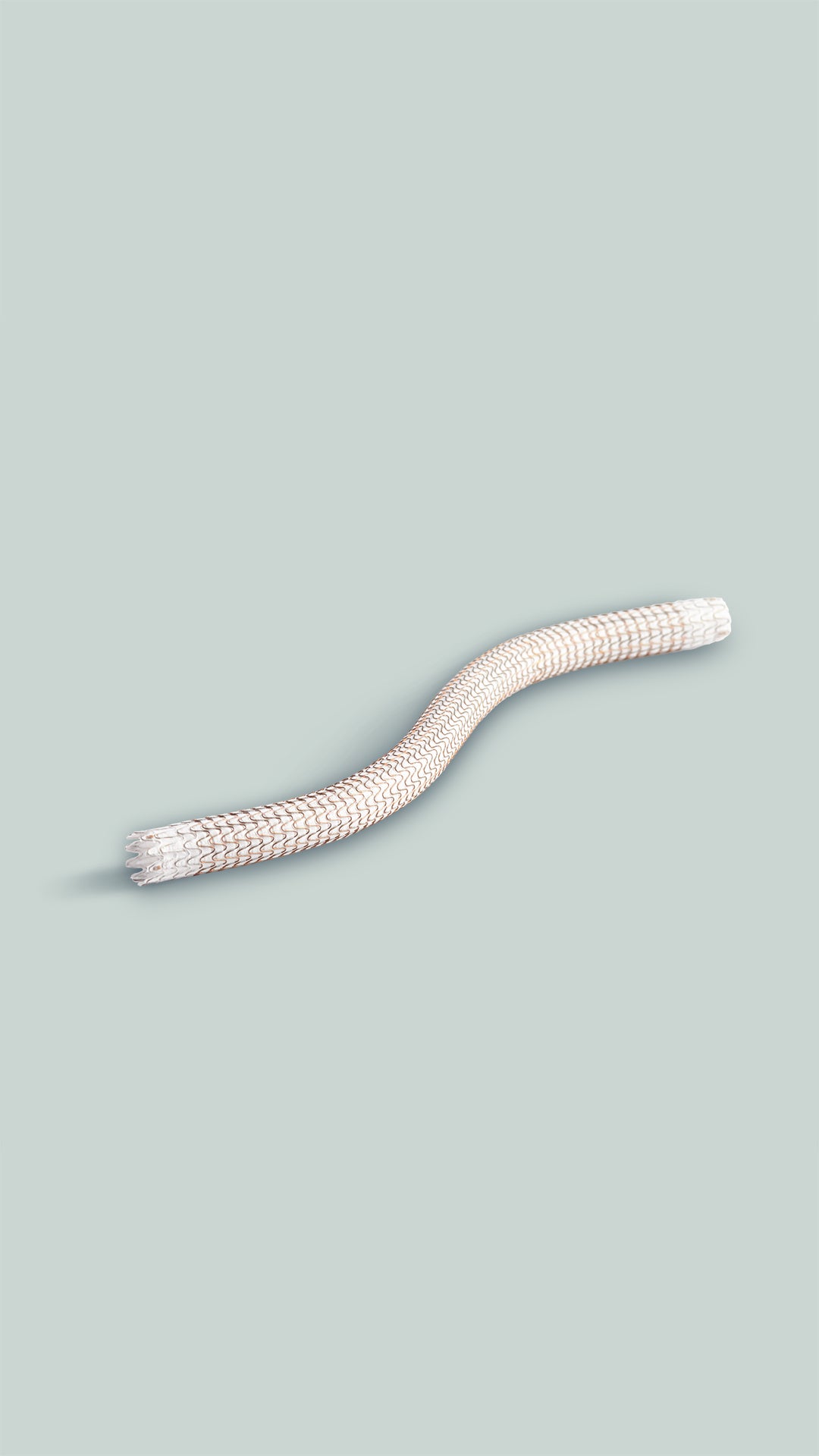
Mit dem GORE® VIABAHN® Implantat, das sich bei einem breiten Spektrum komplizierter Fälle nachweislich bewährt hat, erzielen Sie nachhaltige Behandlungsergebnisse mit hoher Offenheit und minimieren Reinterventionen.
Denken Sie an die Arten von Fällen, die Sie behandeln, und die dabei auftretenden Herausforderungen. Das VIABAHN® Implantat hilft Ihnen dabei, die klinischen Ergebnisse für Ihre Patienten zu optimieren.
Arteriovenöser Zugang (AV-Zugang)
Das VIABAHN® Implantat zeigt bei schwierigsten Fällen von AV-Zugängen einen nachweislichen Erfolg, z. B. bei frühem Versagen nach perkutaner transluminaler Angioplastie (PTA), Läsionen an Flexionspunkten und in thrombosierten Prothesen.
Konzipiert für gute Anpassung an schwierige anatomische Verhältnisse und bewährt bei der Vermeidung von Brüchen†
Nachweisliche Offenheit unabhängig von der Anzahl vorheriger Interventionen1
Erhöhte primäre Offenheitsrate bei thrombosierten Prothesen sowohl der Zielläsion als auch des Circuits im Vergleich zur PTA1
Femoralarterie (AFS)
Das VIABAHN® Implantat bietet bei den schwierigsten Fällen eine beachtliche klinische Leistungsfähigkeit mit einer durchschnittlichen primären Offenheitsrate von 80 %,§ nachgewiesen in sieben multizentrischen, prospektiven, randomisierten oder einarmigen Studien mit einer durchschnittlichen Läsionslänge von 23 cmI und 71 % chronische Totalverschlüsse (CTO).2-8
Vergleichbare klinische Ergebnisse mit supragenualem operativem Bypass (sowohl prothetische als auch native Venen)2,9
Ausgezeichnete Offenheit und Langlebigkeit unabhängig von der Läsionslänge2-6
In-Stent-Restenose (ISR) der AFS
Das VIABAHN® Implantat bietet eine nachhaltige Behandlung komplizierter restenotischer In-Stent-Läsionen.10,11
Kann die Erkrankung abdecken und abdichten, was zu nachhaltigen Ergebnissen bei langstreckigen, komplizierten ISR führt10,11
Iliakalarterie
Das VIABAHN® Implantat ist für die Behandlung von stenotischen Läsionen der Iliakalarterien bestimmt.
Die VIABAHN® Produktlinie zeigt eine nachgewiesene Offenheit auf, die sich den Ergebnissen von operativen Bypässen annähert.12-14
Publikationen
Ihre Quelle für aktuelle Publikationen und klinische Daten, die den Nutzen des VIABAHN® Implantats in der Praxis belegen.
Twelve-month outcomes from the Japanese post-market surveillance study of the Viabahn Endoprosthesis as treatment for symptomatic peripheral arterial disease in the superficial femoral arteries
Iida O, Ohki T, Soga Y, et al. Twelve-month outcomes from the Japanese post-market surveillance study of the Viabahn Endoprosthesis as treatment for symptomatic peripheral arterial disease in the superficial femoral arteries. Journal of Endovascular Therapy 2022;29(6):855-865.
Long-term results of the Japanese multicenter Viabahn trial of heparin bonded endovascular stent grafts for long and complex lesions in the superficial femoral artery
Ohki T, Kichikawa K, Yokoi H, et al. Long-term results of the Japanese multicenter Viabahn trial of heparin bonded endovascular stent grafts for long and complex lesions in the superficial femoral artery. Journal of Vascular Surgery 2021;74(6):1958-1967.e2.
Stent-grafts are the best way to treat complex in-stent restenosis lesions in the superficial femoral artery: 24-month results from a multicenter randomized trial
Bosiers M, Deloose K, Callaert J, et al. Stent-grafts are the best way to treat complex in-stent restenosis lesions in the superficial femoral artery: 24-month results from a multicenter randomized trial. Journal of Cardiovascular Surgery 2020;61(5):617-625.
Clinical and economic benefits of stent grafts in dysfunctional and thrombosed hemodialysis access graft circuits in the revise randomized trial
Mohr BA, Sheen AL, Roy-Chaudhury P, Schultz SR, Aruny JE; REVISE Investigators. Clinical and economic benefits of stent grafts in dysfunctional and thrombosed hemodialysis access graft circuits in the REVISE Randomized Trial. Journal of Vascular & Interventional Radiology 2018;30(2):203-211.e4.
Outcomes of the Japanese multicenter Viabahn trial of endovascular stent grafting for superficial femoral artery lesions
Ohki T, Kichikawa K, Yokoi H, et al. Outcomes of the Japanese multicenter Viabahn trial of endovascular stent grafting for superficial femoral artery lesions. Journal of Vascular Surgery 2017;66(1):130-142.e1.
1-year results of a multicenter randomized controlled trial comparing the heparin-bonded endoluminal bypass to the femoropopliteal bypass
Reijnen MMPJ, van Walraven LA, Fritschy WM, et al. 1-year results of a multicenter randomized controlled trial comparing heparin-bonded endoluminal to femoropopliteal bypass. JACC: Cardiovascular Interventions 2017;10(22):2320-2331.
Sustained benefit at 2 years for covered stents versus bare-metal stents in long SFA lesions: the VIASTAR trial
Lammer J, Zeller T, Hausegger KA, et al. Sustained benefit at 2 years for covered stents versus bare-metal stents in long SFA lesions: the VIASTAR trial. Cardiovascular & Interventional Radiology 2015;38(1):25-32.
Heparin-bonded, expanded polytetrafluoroethylene-lined stent graft in the treatment of femoropopliteal artery disease: 1-year results of the VIPER (Viabahn Endoprosthesis with Heparin Bioactive Surface in the treatment of Superficial Femoral Artery Obstructive Disease) Trial
Saxon RR, Chervu A, Jones PA, et al. Heparin-bonded, expanded polytetrafluoroethylene-lined stent graft in the treatment of femoropopliteal artery disease: 1-year results of the VIPER (Viabahn Endoprosthesis with Heparin Bioactive Surface in the Treatment of Superficial Femoral Artery Obstructive Disease) Trial. Journal of Vascular & Interventional Radiology 2013;24(2):165 173.
* Bioaktive PROPATEN Oberfläche bezieht sich bei Gore auf die firmeneigene CBAS®‑Heparin‑Oberfläche.
†Für die GORE® VIABAHN® Endoprothese wurde eine Frakturrate von 0,0013 % für alle Anwendungen dokumentiert (Daten liegen vor, 2025; W. L. Gore & Associates, Inc; Flagstaff, AZ.)
‡ Gewichtetes Mittel der primären Offenheit nach einem Jahr.
I Gewichtete durchschnittliche Läsionslänge.
- Vesely T, DaVanzo W, Behrend T, Dwyer A, Aruny J. Balloon angioplasty versus Viabahn stent graft for treatment of failing or thrombosed prosthetic hemodialysis grafts. Journal of Vascular Surgery 2016;64(5):1400-1410.e1. http://www.sciencedirect.com/science/article/pii/S0741521416301756
- Reijnen M, van Walraven L, Fritschy W, et al. 1-year results of a multicenter, randomized controlled trial comparing heparin-bonded endoluminal to femoropopliteal bypass. Journal of Cardiovascular Interventions 2107;10(22):2320-2331.
- Ohki T, Kichikawa K, Yokoi H, et al. Long-term results of the Japanese multicenter Viabahn trial of heparin bonded endovascular stent grafts for long and complex lesions in the superficial femoral artery. Journal of Vascular Surgery 2021;74(6):1958-1967.e2.
- Saxon RR, Chervu A, Jones PA, et al. Heparin-bonded, expanded polytetrafluoroethylene-lined stent graft in the treatment of femoropopliteal artery disease: 1-year results of the VIPER (Viabahn Endoprosthesis with Heparin-bonded Bioactive Surface in the Treatment of Superficial Femoral Artery Obstructive Disease) Trial. Journal of Vascular & Interventional Radiology 2013;24(2):165-173.
- Lammer J, Zeller T, Hausegger KA, et al. Sustained benefit at 2 years for covered stents versus bare-metal stents in long SFA lesions: the VIASTAR Trial. Cardiovascular & Interventional Radiology 2015;38(1):25-32.
- Zeller T, Peeters P, Bosiers M, et al. Heparin-bonded stent-graft for the treatment of TASC II C and D femoropopliteal lesions: the Viabahn-25 cm Trial. Journal of Endovascular Therapy 2014;21(6):765-774.
- Iida O, Ohki T, Soga Y, et al. Twelve-month outcomes from the Japanese post-market surveillance study of the Viabahn Endoprosthesis as treatment for symptomatic peripheral arterial disease in the superficial femoral arteries. Journal of Endovascular Therapy 2022;29(6):855-865.
- Iida O, Takahara M, Soga Y, et al; VANQUISH Investigators. One-year outcomes of heparin-bonded stent-graft therapy for real-world femoropopliteal lesions and the association of patency with the prothrombotic state based on the prospective, observational, multicenter Viabahn Stent-Graft Placement for Femoropopliteal Diseases Requiring Endovascular Therapy (VANQUISH) Study. Journal of Endovascular Therapy 2021;28(1):123-131.
- McQuade K, Gable D, Pearl G, Theune B, Black S. Four-year randomized prospective comparison of percutaneous ePTFE/nitinol self-expanding stent graft versus prosthetic femoral-popliteal bypass in the treatment of superficial femoral artery occlusive disease. Journal of Vascular Surgery 2010;52(3):584-591.
- Bosiers M, Deloose K, Callaert J, et al. Stent-grafts are the best way to treat complex in-stent restenosis lesions in the superficial femoral artery: 24-month results from a multicenter randomized trial. The Journal of Cardiovascular Surgery 2020;61(5):617-25
- Soukas P, Becker M, Stark K, Tepe G; RELINE MAX Investigators. Three-year results of the GORE® VIABAHN® endoprosthesis in the superficial femoral artery for in-stent restenosis. Journal of the Society for Cardiovascular Angiography & Interventions 2023;2(6)Part A:101183.
- Lammer J, Dake M.D., Bleyn J, et al. Peripheral arterial obstruction: prospective study of treatment with a transluminally placed self-expanding stent graft. Radiology 2000;217(1):95-104.
- Bismuth J, Gray BH, Holden A, Metzger C, Panneton J; VBX FLEX Study Investigators. Pivotal study of a next-generation balloon-expandable stent-graft for treatment of iliac occlusive disease. Journal of Endovascular Therapy 2017;24(5):629-637. Pivotal Study of a Next-Generation Balloon-Expandable Stent-Graft for Treatment of Iliac Occlusive Disease - Jean Bismuth, Bruce H. Gray, Andrew Holden, Christopher Metzger, Jean Panneton, , on behalf of the VBX FLEX Study Investigators, on behalf of the VBX FLEX Study Investigators, 2017
- Indes JE, Pfaff MJ, Farrokhyar F, et al. Clinical outcomes of 5358 patients undergoing direct open bypass or endovascular treatment for aortoiliac occlusive disease: a systematic review and meta-analysis. Journal of Endovascular Therapy 2013;20(4):443-455.
Golchehr B, Zeebregts CJ, Reijnen MMPJ, Tielliu IFJ. Long-term outcome of endovascular popliteal artery aneurysm repair. Journal of Vascular Surgery 2018;67(6):1797-1804.

Eine vollständige Beschreibung aller geltenden Indikationen, Warnhinweise, Vorsichtsmaßnahmen und Kontraindikationen für die Länder, in denen dieses Produkt angeboten wird, finden Sie in der Gebrauchsanweisung unter eifu.goremedical.com. RXOnly
INDIKATIONEN IN EUROPA: Die GORE® VIABAHN® Endoprothese mit bioaktiver PROPATEN Oberfläche ist zur Behandlung in den folgenden Fällen indiziert:
- De-novo-Läsionen oder restenotische Läsionen der Iliakalarterien
- De-novo-Läsionen oder restenotische Läsionen der A. femoralis superficialis und der proximalen A. poplitea
- Restenotische In-Stent-Läsionen der A. femoralis superficialis und der proximalen A. poplitea
- Stenose oder thrombotischer Verschluss an der venösen Anastomose synthetischer arteriovenöser Gefäßprothesen (AV-Zugänge) und im venösen Abstrom bei Shunts von Dialysezugängen, einschließlich der zentralen Venen
- Poplitealarterienaneurysmen und isolierte Viszeralarterienaneurysmen
- Traumatische oder iatrogene Gefäßschädigungen von Arterien, die sich in der Brusthöhle, im Bauchraum oder im Becken befinden (außer Aorta, Koronararterien, Truncus brachiocephalicus, Karotiden, A. vertebralis und A. pulmonalis)
KONTRAINDIKATIONEN:
- Nicht-elastische Läsionen, bei denen während der Prädilatation keine vollständige Aufdehnung des Angioplastie-Ballonkatheters erzielt wurde bzw. bei denen die Läsion nicht ausreichend aufgedehnt werden kann, um die Passage des Applikationssystems zu ermöglichen.
- Die GORE® VIABAHN® Endoprothese mit bioaktiver PROPATEN Oberfläche darf bei Patienten mit bekannter Überempfindlichkeit gegen Heparin nicht verwendet werden. Dies gilt insbesondere auch für die Patienten, bei denen in der Vergangenheit eine heparininduzierte Thrombozytopenie (HIT) vom Typ II aufgetreten ist.